Humanoid Robot Delivers Real-Time Force Feedback in VR Driving Simulator, Study Shows
A research team has successfully used a humanoid robot to provide immersive force feedback in a virtual reality driving simulator, demonstrating a novel use of general-purpose robotics. The system, built around a Unitree G1 robot, physically moves a player's chair in real-time to match G-forces experienced in the game Assetto Corsa.
"This is the first time a humanoid robot has been employed as a haptic medium for VR driving without any hardware modifications," said Dr. Alex Chen, lead researcher at the project's lab. "Participants reported an accurate and highly enjoyable sense of motion."
Background
Humanoid robots are emerging as versatile platforms. Instead of building a dedicated force feedback chair, the team repurposed an off-the-shelf Unitree G1. The robot sits behind the player, uses its depth camera to track spherical markers on the chair, and grips it with articulated hands. Real-time G-force data from the simulator commands the robot to push or pull the chair in sync with in-game events such as acceleration, braking, and cornering.
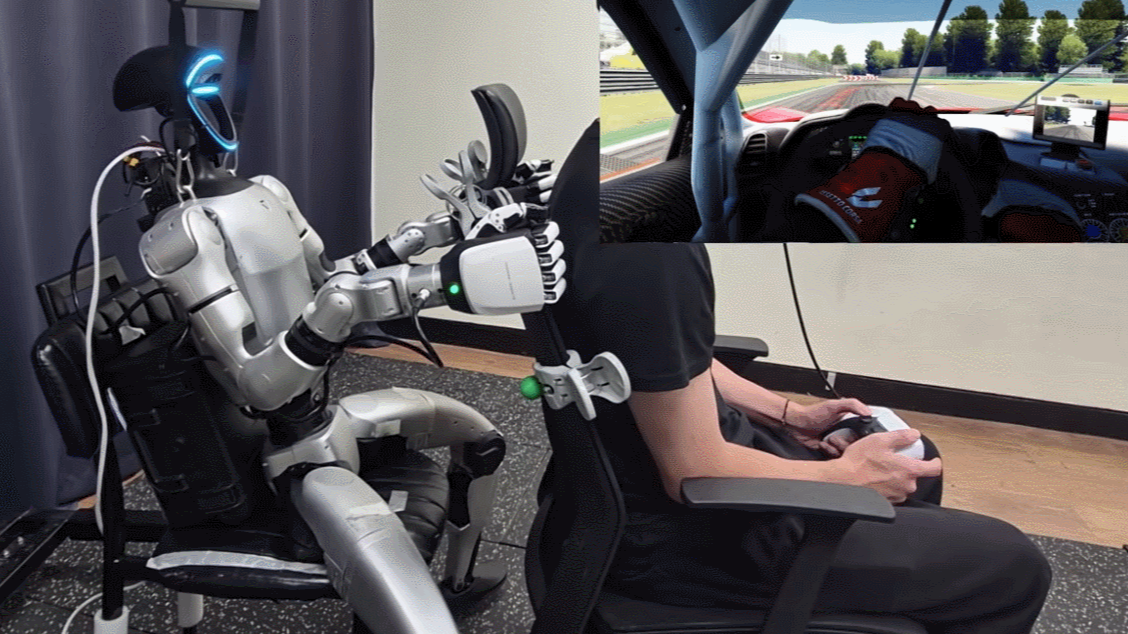
"No hardware modifications were needed," explained Dr. Chen. "The robot simply uses its camera and hands to become a general-purpose feedback device."
How It Works
- Robot Setup: Unitree G1 sits behind the player's chair, grasps it with both hands.
- Tracking: Spherical markers on the chair allow the robot's depth camera to determine position.
- Data Input: Real-time G-force signals from Assetto Corsa running on a PC direct the robot's movements.
- Motion Output: The robot shifts the chair forward, backward, or sideways to match simulated forces.
Participant Feedback
Test subjects found the synchronized motion accurate and enjoyable. "It felt like the car was really moving me," said one participant. However, some noted drawbacks. Sustained motion and constant vibration proved tiring, and a few users reported worsened VR sickness.
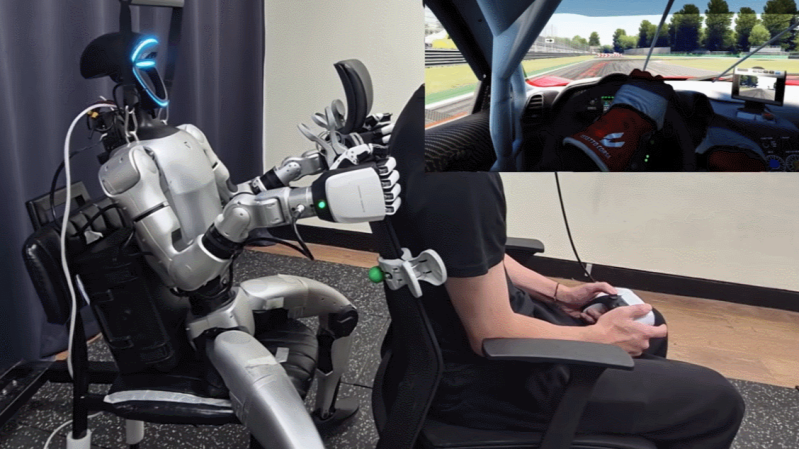
"We observed that prolonged intense motion could fatigue players," noted researcher Maria Lopez. "But for short sessions, the immersion was remarkable."
What This Means
This proof-of-concept shows humanoid robots can serve as flexible, general-purpose haptic devices. Instead of buying specialized force feedback chairs, future VR setups might simply use a robot that can also perform other tasks. The approach could extend beyond driving to flight simulators, roller coaster experiences, or even physical rehabilitation.
"The conceptual success here opens the door for robots that adapt to different applications," Dr. Chen said. "You don't need a dedicated machine for each type of feedback."
While a humanoid robot like the Unitree G1 currently costs thousands of dollars, the team believes mass adoption and multi-purpose use could bring costs down. The research paper, available online, includes video demonstrations and detailed technical setups.
For more, see the team's background section or explore the technical details.
Related Articles
- 6 Ways to Secure Windows Credentials and Access with Boundary and Vault
- Fortifying Your Enterprise Against AI-Driven Vulnerability Discovery: A Defensive Guide
- Mastering Couch Computing: A Complete Guide to Framework’s Wireless TouchPad Keyboard
- How to Prioritize and Apply Microsoft's March 2026 Patch Tuesday Updates
- How to Harden Your vSphere Environment Against BRICKSTORM Malware
- How to Defend Your Organization Against ClickFix Attacks Distributing Vidar Stealer
- OpenAI Unveils Daybreak: AI Security Initiative Countering Anthropic's Claude Mythos
- Weekly Cyber Threat Digest: May 4th – Major Breaches, AI-Powered Attacks, and Critical Patches