25 Years of Mars Odyssey: 10 Milestones and Discoveries
Twenty-five years ago, NASA’s 2001 Mars Odyssey orbiter embarked on a journey that would redefine our understanding of the Red Planet. On April 7, 2001, it launched from Cape Canaveral, and since then, it has been mapping Mars’s surface, searching for water ice, and providing invaluable data for scientists and future missions. In April 2026, the team behind this pioneering mission gathered at NASA’s Jet Propulsion Laboratory to celebrate a quarter-century of achievements, rolling out a stunning global map of Mars created using the THEMIS infrared camera. This listicle covers the key moments and contributions that make Odyssey a true trailblazer in planetary exploration.
1. Historic Launch and a New Era of Exploration
Odyssey lifted off on April 7, 2001, from Cape Canaveral Air Force Station, marking the beginning of NASA’s longest-running Mars mission. Its primary goals were to map the planet’s surface, study its climate and geology, and identify water ice deposits. The spacecraft arrived at Mars in October 2001 after a six-month journey, becoming the first successful orbiter under NASA’s Mars Exploration Program since the Mars Polar Lander setback. Odyssey’s launch not only demonstrated resilience but also set the stage for a new era of sustained robotic exploration of Mars.
2. The THEMIS Instrument: A Window into Mars’s Secrets
At the heart of Odyssey’s success is the Thermal Emission Imaging System (THEMIS), a multi-band infrared camera. THEMIS captures images in both visible and infrared wavelengths, allowing scientists to map surface mineralogy, temperature variations, and thermal inertia. By detecting heat signatures, THEMIS can identify rock types like basalt, olivine, and carbonates, as well as buried water ice. This instrument has been crucial for selecting landing sites and understanding Mars’s geologic history. The global map created for Odyssey’s 25th anniversary is a breathtaking mosaic of THEMIS infrared data, showcasing the planet’s diverse terrains.
3. Building the Ultimate Global Map of Mars
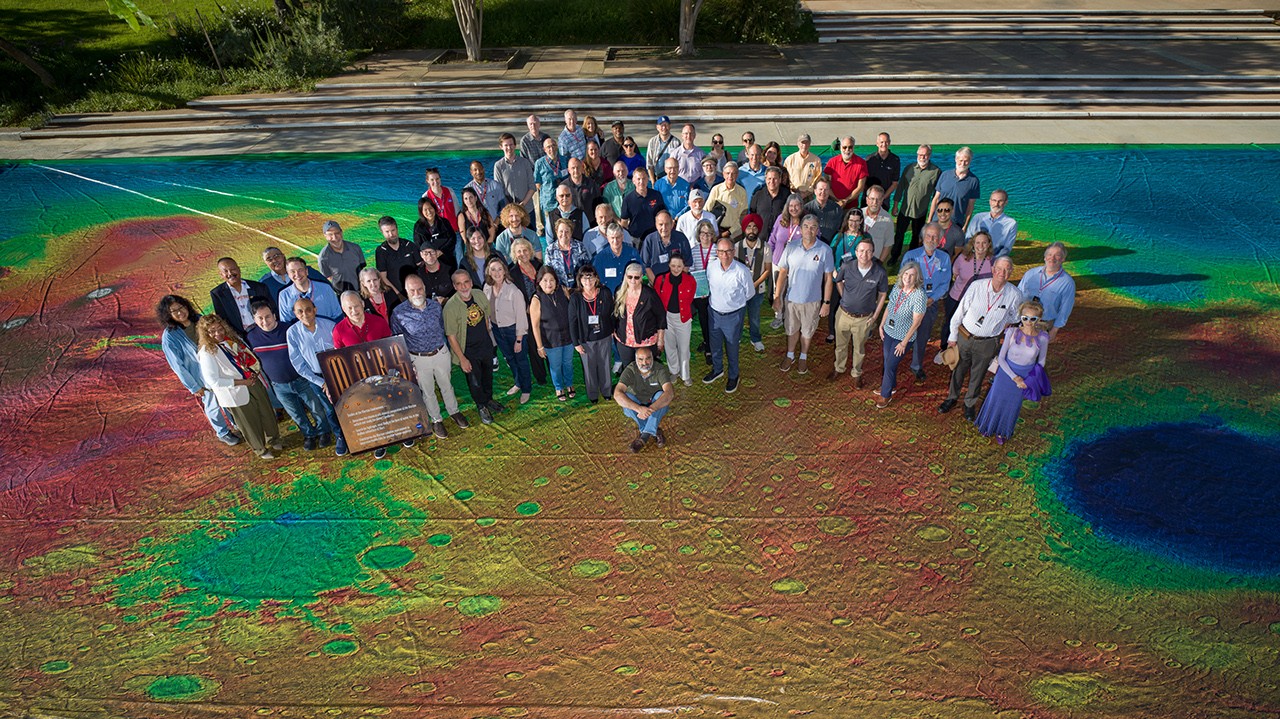
Using nearly two decades of THEMIS observations, the Odyssey team assembled a seamless, high-resolution global map of Mars. This map, unveiled during the April 2026 celebration at JPL, covers the entire planet in infrared detail, revealing features like Olympus Mons, Valles Marineris, and the polar ice caps. The mosaic required careful calibration to correct for seasonal and atmospheric variations, resulting in a resource that will aid future missions, including sample return and human exploration. It’s a testament to Odyssey’s endurance and the power of long-term monitoring.
4. Celebrating 25 Years at JPL
On April 15, 2026, current and former mission team members gathered at NASA’s Jet Propulsion Laboratory in Southern California to mark the 25th anniversary of Odyssey’s launch. The celebration featured speeches, photo opportunities, and the dramatic unrolling of the giant global map. This event honored the dedication of hundreds of scientists and engineers who have kept the orbiter operating far beyond its original design life. JPL leads the mission, and the festive atmosphere reflected pride in a mission that continues to deliver every day.
5. The People Behind the Mission
Odyssey’s longevity is a direct result of the expertise and passion of its team members, many of whom have been with the mission since its inception. From the engineers who operate the spacecraft daily to the scientists who analyze THEMIS data, their collaborative spirit keeps the orbiter thriving. The April 2026 reunion brought together veterans and newer members, highlighting how institutional knowledge is passed down. Their work has not only advanced Mars science but also trained the next generation of planetary explorers.
6. Major Scientific Contributions: Water Ice and More
Odyssey’s most celebrated discovery is detecting vast deposits of water ice beneath Mars’s surface, particularly in the mid-latitudes using the Gamma Ray Spectrometer. This finding has profound implications for future human missions, providing a potential resource for drinking water and rocket fuel. Additionally, THEMIS has mapped mineral distributions, found evidence of recent volcanic activity, and monitored seasonal changes. Odyssey also served as a communication relay for the Spirit and Opportunity rovers, proving its value as a multi-purpose asset.

7. Breaking Records: NASA’s Longest-Working Mars Orbiter
In December 2010, Odyssey surpassed the Mars Global Surveyor to become the longest-operating spacecraft at Mars. By 2026, it had circled the planet more than 100,000 times, far exceeding its expected one-year primary mission. Its robust design and regular software updates have allowed it to endure harsh radiation, dust storms, and extreme temperatures. This record-breaking longevity makes Odyssey a benchmark for spacecraft reliability and a model for future long-duration missions.
8. The Power of Infrared Imaging
THEMIS’s infrared capabilities allow Odyssey to see Mars in ways visible-light cameras cannot. Infrared imaging reveals the planet’s thermal properties, such as how quickly the surface cools at night, which indicates rock type and particle size. It can also penetrate thin dust hazes to reveal underlying geology. This technology has been essential for mapping thermophysical units, detecting subsurface ice, and monitoring frost. Without the infrared eye of THEMIS, many of Mars’s secrets would remain hidden.
9. Legacy for Future Missions
Odyssey’s global map is already guiding the next wave of Mars exploration. The high-resolution infrared data helps planners select safe landing sites for rovers and landers, including NASA’s Mars 2020 Perseverance and the upcoming Mars Sample Return. The map also supports habitat design studies by highlighting regions with accessible water ice. Furthermore, Odyssey’s operational experience informs the development of future orbiters, like the Mars Orbiter Mission, ensuring that its knowledge will benefit missions for decades to come.
10. Looking Ahead: A Mission Without an End Date
As of 2026, Odyssey remains fully functional, with no planned retirement. The team continues to refine its orbit and manage fuel, aiming to operate well into the 2030s. With the upcoming Mars Sample Return campaign requiring extensive relay support, Odyssey’s proven communication suite will be invaluable. Its legacy as a workhorse orbiter and the foundation for a global map ensures that even when it finally ceases, its contributions will persist through data archives and scientific discoveries.
Celebrating 25 years on a global map of Mars is more than a milestone—it symbolizes human ingenuity and the relentless pursuit of knowledge. The Odyssey team’s dedication has given us a clearer picture of our neighboring planet, answering old questions while raising new ones. As the orbiter continues its silent vigil, it reminds us that exploration is a marathon, not a sprint, and that each mission builds upon the last. Here’s to the next 25 years of uncovering the mysteries of Mars.
Related Articles
- Vacuum Maker Dreame Stuns Auto World with 0.9-Second Rocket Car
- Unlocking Plant Cloning: The Master Switch Gene for Asexual Reproduction Revealed
- 10 Game-Changing Outcomes from the Santa Marta Fossil Fuel Transition Summit
- Ransomware in Early 2026: Market Consolidation and Dominant Players
- 10 Breakthroughs in Liquid Crystal Control: How a Hidden Threshold Unlocks Energy-Efficient Technologies
- The Container: Humanity's First and Most Essential Tool
- AI-Powered Science Assistants Take on Drug Repurposing
- Three Tech Trends Reshaping Our Future: IVF Innovations, Balcony Solar, and the Rise of AI Resistance